
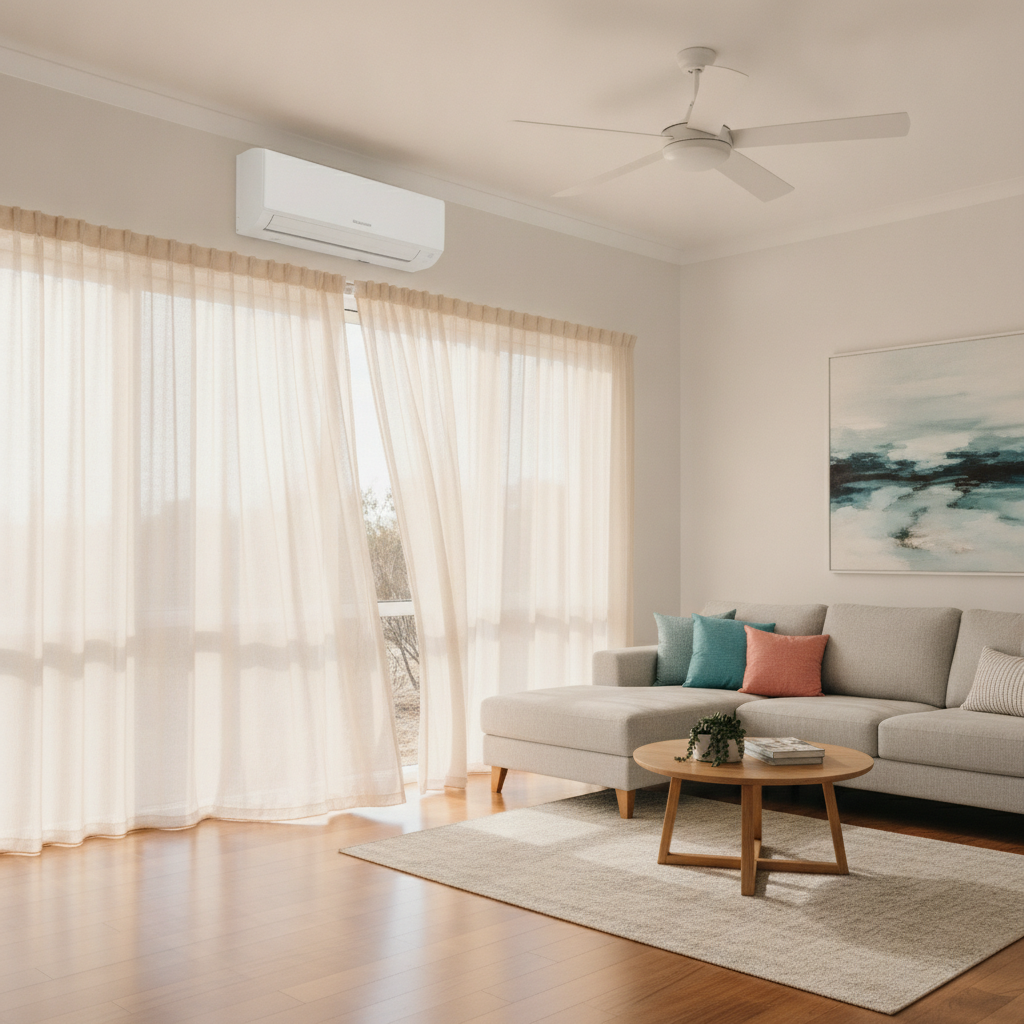
Last updated 24 August 2026·Quotcha editorial team — built from real Australian quote data
In this guide
The installation quote is a one-off. The running cost arrives every quarter for fifteen years, and it is the number most people never calculate before buying. A 2.5kW split system in a bedroom costs 20 to 35 cents an hour to run in 2026. A 7kW living-area unit costs 55 cents to $1.10 an hour. A ducted system cooling a whole house runs $1.50 to $3.50 an hour, which over a hot summer is the difference between a $150 and a $700 electricity bill.
Here are the real hourly and seasonal numbers by system size, why a bigger unit is not a better one, and the settings that cut the bill by a third without touching comfort.
Running cost per hour by system size
Assumes a modern inverter reverse-cycle unit, a mid-range energy rating, and an electricity price of 32 cents per kWh (the 2026 average across the capital cities; Sydney and Adelaide are higher, Brisbane and Perth lower). Costs shown for cooling on a hot day; heating in winter is similar or slightly cheaper for a reverse-cycle unit.
- 2.5kW (bedroom, 10 to 20m2): 0.6 to 1.0 kWh drawn, 20 to 35 cents an hour
- 3.5kW (large bedroom or study, 20 to 30m2): 0.9 to 1.3 kWh, 30 to 45 cents
- 5kW (living room, 30 to 45m2): 1.3 to 1.9 kWh, 40 to 65 cents
- 7kW (open plan living, 45 to 65m2): 1.8 to 2.8 kWh, 55 cents to $1.10
- 9kW (large open plan, 65 to 90m2): 2.4 to 3.5 kWh, 75 cents to $1.40
- Ducted, 14kW (3 bedroom house, all zones): 4 to 7 kWh, $1.50 to $2.50
- Ducted, 18kW to 24kW (4 to 5 bedroom house): 6 to 10 kWh, $2.00 to $3.50
Those are running figures once the room is at temperature. The first 20 to 40 minutes, when the unit is pulling the room down from 32C to 24C, draws close to the maximum. An inverter unit then throttles back to a fraction of that to hold the temperature. A non-inverter unit cycles fully on and fully off, which is why old units cost 30 to 40 percent more to run.
What that means per season
For a household that runs the living area unit six hours a day on the 90 hottest days of summer:
- 5kW split: around $250 to $350 for the summer
- 7kW split: around $300 to $600
- Ducted, whole house, all zones: around $800 to $1,900
Winter heating with a reverse-cycle unit costs about the same per hour but is usually run for more hours, so in Melbourne, Canberra, Hobart and Adelaide the heating season often costs more than summer. Even so, reverse-cycle heating costs roughly a third of a resistive electric heater delivering the same warmth, because it moves heat instead of generating it.
Why oversizing costs you twice
The most common sizing mistake is buying a bigger unit "to be safe". An oversized unit reaches the set temperature fast, shuts down, and restarts a few minutes later. Short cycling wears the compressor, fails to dehumidify (the room feels clammy at 24C), and uses more power than a correctly sized unit running steadily. It also costs more to buy.
Rough sizing for a modern, insulated Australian home:
- 10 to 20m2: 2.5kW
- 20 to 30m2: 3.5kW
- 30 to 45m2: 5kW
- 45 to 65m2: 7kW
- 65 to 90m2: 9kW
Add 10 to 20 percent for west-facing rooms with afternoon sun, high ceilings, large windows or poor insulation. Subtract for well-shaded, well-insulated rooms. A good installer does a heat load calculation rather than picking from a chart; ask for it.
Get a quote in your suburb
See real prices for jobs like this in your area — we use actual quote data from local tradies.
The energy star rating, in dollars
The Zoned Energy Rating Label on every new unit shows separate star ratings for hot, mixed and cold climate zones, and an annual energy figure in kWh. That kWh figure is the one to compare.
Between a 2-star and a 5-star 7kW unit, the difference is typically 400 to 700 kWh a year, or $130 to $220 at 2026 prices. Over a 12 year life that is $1,500 to $2,600, which comfortably covers the $400 to $800 higher purchase price of the efficient unit. Between 5 and 7 stars the gap narrows and the premium is harder to justify unless you run the unit heavily.
Daikin, Mitsubishi Electric, Fujitsu, Panasonic and Mitsubishi Heavy Industries all have ranges at 4.5 to 6 stars in the common sizes. The cheaper end of the market (2 to 3 stars) is cheap because of the compressor and the refrigerant circuit, and that shows up on the bill.
Settings that cut the bill by a third
Set 24C to 26C for cooling, 18C to 20C for heating. Every degree lower in summer or higher in winter adds roughly 10 percent to running cost. Cooling to 21C on a 35C day costs 40 to 50 percent more than cooling to 25C.
Use the fan, not the compressor, where possible. A ceiling fan at 3 cents an hour lets you set the air conditioner 2 degrees higher for the same feel.
Zone a ducted system. Cooling four unused bedrooms to cool one living room is where ducted bills explode. Close zones you are not in. If your system does not have zoning, adding motorised dampers is $1,500 to $3,000 and pays for itself in two summers.
Close the house up before the heat, not after. Shut blinds on the sun side by mid-morning. The unit works far harder pulling a room down from 33C than holding it at 25C.
Pre-cool on solar. If you have rooftop solar, run the unit hard between 11am and 3pm when the panels are producing, and let it coast in the evening. Free kilowatt-hours beat cheap ones.
Clean the filters. A clogged filter cuts airflow and pushes the compressor to work harder. Every month in summer, five minutes. A serviced unit uses 5 to 15 percent less power than a neglected one.
Do not leave it on all day to "save the effort of cooling down". For a modern inverter unit in an insulated house, turning it off when you leave and on when you return is cheaper than holding temperature in an empty house for eight hours.
Old unit or new unit?
A 15 year old non-inverter 5kW unit at 2 stars uses roughly 2 to 2.5 kWh an hour where a new 5-star inverter uses 1.3 to 1.6. On six hours a day over summer that is $150 to $250 a year, and the old unit is probably on R22 or R410A refrigerant, which is expensive or impossible to top up. If the old unit needs a repair over $500, put the money toward a replacement.
The bottom line
Budget 20 to 35 cents an hour for a bedroom split, 55 cents to $1.10 for a living-area split, and $1.50 to $3.50 for ducted. Size the unit to the room rather than up, pay for the stars in the sizes you run most, set 24C to 26C, zone what you are not using, and clean the filters. Together those habits cut the summer bill by a third, which over the life of the system is worth more than any discount on the install.
Frequently asked questions
How much does it cost to run an air conditioner per hour?
At the 2026 average electricity price of 32 cents per kWh, a 2.5kW bedroom split costs 20 to 35 cents an hour, a 5kW living room unit 40 to 65 cents, a 7kW open plan unit 55 cents to $1.10, and a ducted system cooling a whole house $1.50 to $3.50. Those are steady-state figures for a modern inverter unit once the room is at temperature; the first 20 to 40 minutes draw close to maximum.
Is it cheaper to leave the air conditioner on all day?
Not for a modern inverter unit in a reasonably insulated house. Holding temperature in an empty home for eight hours costs more than turning the unit off when you leave and on when you return. The exception is a poorly insulated house on a very hot day, where the recovery load can approach the holding load, but even then the saving from leaving it on is small.
What temperature should I set my air conditioner to save money?
24C to 26C for cooling and 18C to 20C for heating. Every degree lower in summer or higher in winter adds roughly 10 percent to the running cost, so cooling to 21C on a 35C day costs 40 to 50 percent more than cooling to 25C. A ceiling fan at 3 cents an hour lets you set the air conditioner two degrees higher for the same comfort.
Is a bigger air conditioner better?
No. An oversized unit reaches the set temperature quickly, shuts off, and restarts minutes later. That short cycling wears the compressor, fails to dehumidify so the room feels clammy, and uses more power than a correctly sized unit running steadily. Size to the room: roughly 2.5kW for 10 to 20 square metres, 5kW for 30 to 45, 7kW for 45 to 65, adjusted for sun exposure and insulation.
How much does the energy star rating actually save?
Between a 2-star and a 5-star 7kW unit the difference is typically 400 to 700 kWh a year, or $130 to $220 at 2026 prices, which over a 12 year life is $1,500 to $2,600 and comfortably covers the $400 to $800 higher purchase price. Between 5 and 7 stars the gap narrows and the premium is only worth it for heavily used units.
How much does ducted air conditioning cost to run per day?
A 14kW ducted system cooling a three bedroom house with all zones open draws 4 to 7 kWh an hour, so eight hours on a hot day costs $10 to $18. Zoning is the biggest lever: closing bedrooms you are not using can halve that. If your system has no zoning, adding motorised dampers costs $1,500 to $3,000 and typically pays for itself within two summers.
Related guides
Air Con Service & Maintenance Australia: When, How Often, Cost (2026)
Air con servicing in Australia: how often to book, what techs actually do, real 2026 costs ($130-$450), DIY tasks vs ARCtick-only work.
Ducted Air Conditioning Cost Australia (2026): Real Pricing Guide
Real ducted air conditioning cost in Australia: $9k-$25k+ installed by home size, brand, and zoning. Quote red flags and running costs explained.
Split System Air Conditioner Installation Cost Australia (2026)
Split system installation cost in Australia: $1,200 for 2.5kW back-to-back, $2,800-$4,500 for 9kW. Real line items, ARCtick rules, what changes the price.