
Last updated 12 May 2026·Quotcha editorial team — built from real Australian quote data
In this guide
Most Australian homeowners pay between $1,200 and $4,500 to have a split system air conditioner supplied and installed in 2026, depending on the kW capacity, the brand, and how complex the install is. A simple back-to-back 2.5kW bedroom unit sits at the bottom of that range; a 9kW living-area unit on a double-brick wall with a long pipe run sits at the top. Anything outside that band — either much cheaper or much dearer — usually means a line item is missing from the quote, or the installer is charging premium-brand pricing for the unit and standard pricing for the labour.
How much does split system installation cost in Australia?
Here's the realistic 2026 price band for a single-head wall-mounted reverse-cycle split system, supplied and installed by an ARCtick-licensed installer:
- 2.5kW (small bedroom, study): $1,200 - $1,800 installed
- 3.5kW (large bedroom, small living): $1,500 - $2,200 installed
- 5.0kW (open-plan living, master suite): $1,800 - $2,800 installed
- 7.0kW (large living area): $2,200 - $3,500 installed
- 9.0kW (whole open-plan zone): $2,800 - $4,500 installed
These figures assume a back-to-back install on a brick veneer wall, with the outdoor condenser within 3 metres of the indoor head, a standard single-phase power point already nearby, and no removal of an existing unit. Strip those assumptions away — long pipe runs, double brick, bracket-mounted condensers, new circuits — and you can add $400 to $1,500 on top.
The unit itself usually accounts for 50-60% of the total invoice. The rest is installation labour, materials (copper pipe, drain line, insulation, mounting hardware), electrical work, and the certificate of compliance. People are often surprised how little of the bill is the box on the wall.
Cost by system capacity (kW)
Split system pricing scales with capacity, but not linearly — going from 5kW to 7kW only adds about $400-$700 to the unit cost, while jumping from 7kW to 9kW often adds $600-$1,000 because you're crossing into a different chassis size and sometimes a different power requirement.
2.5kW ($1,200 - $1,800 installed) — Sized for rooms up to about 25m². Mid-range options include the Fujitsu Lifestyle Range, Mitsubishi Heavy Industries Bronte, and Panasonic Z-Series. Daikin Cora at this capacity pushes you to the top of the band. Cheap budget brands (Hisense, Kelvinator, Teco) can come in at $950-$1,100 installed but expect a 3-year warranty rather than 5.
3.5kW ($1,500 - $2,200 installed) — Suitable for rooms 25-35m². The most common bedroom-and-study upgrade. A Mitsubishi Electric MSZ-AP35 or Daikin Lite at this capacity sits around $1,900-$2,100 installed in most metro areas.
5.0kW ($1,800 - $2,800 installed) — The default open-plan-living size for a typical 3-bedroom home. This is where the brand decision matters most: a Fujitsu Lifestyle 5kW lands around $1,900-$2,100 installed, while a Daikin Cora 5kW or Mitsubishi Electric MSZ-AP50 lands around $2,400-$2,800 installed. The premium buys you a quieter compressor, better part-load efficiency (your power bill in mild weather), and a longer track record on inverter board reliability.
7.0kW ($2,200 - $3,500 installed) — Used for large open-plan zones or knockdown-rebuild great rooms. At this size you should be checking the unit is single-phase compatible — some 7kW models, and most 9kW+ models, are sold in single and three-phase variants and getting the wrong one is an expensive mistake.
9.0kW ($2,800 - $4,500 installed) — Big living-area or two-zone open-plan. Many 9kW units are three-phase only or strongly recommend a 32A circuit. If your switchboard is older than ~2005, factor in a possible upgrade to handle the load (often $800-$1,500 separately).
What changes the price the most
In rough order of impact on the final invoice:
1. Brand and model tier. A like-for-like 5kW comparison — Hisense vs Fujitsu Lifestyle vs Daikin Cora vs Mitsubishi Electric MSZ-AP — can swing the unit cost by $1,200 alone. Daikin and Mitsubishi Electric command a 20-35% premium over Fujitsu and Panasonic for the same kW.
2. Pipe run length. Standard installs include up to 3m of insulated copper refrigerant line. Every additional metre is typically billed at $40-$80, and once you go past about 7m the installer needs to add refrigerant (R32) on commissioning, which is a separate line item ($80-$150).
3. Wall type and penetration. Brick veneer is standard. Double brick adds $80-$200 (longer drill bit, more time). Rendered or tiled walls usually add $100-$250 to make the penetration look clean. Weatherboard or cladded walls are quick but need flashing to prevent water ingress.
4. Condenser mounting. Ground level on a concrete pad: included or +$50. Wall bracket up to first-floor height: +$150-$300. Roof mount or anything requiring scaffolding/edge protection: +$400-$1,000.
5. Electrical work. A new dedicated RCBO and circuit run from the switchboard adds $300-$600 typically. A switchboard upgrade if you're at capacity is a separate trade entirely. All electrical work must comply with AS/NZS 3000 and be certified.
6. Old unit removal. Decommissioning the refrigerant (legally, the old unit must be degassed under ARCtick rules), removing the head and condenser, patching the wall: $150-$350. Don't let an installer just "vent" old refrigerant — it's illegal and a fineable offence.
7. State and metro vs regional. Sydney and Melbourne metro labour rates are highest. Brisbane and Perth sit roughly 10-15% lower for equivalent jobs. Regional areas are mixed: less labour competition can push prices up, but lower overheads sometimes balance it. WA in particular has fewer ARCtick-licensed installers per capita, which keeps install rates firmer than NSW.
Single vs back-to-back installs explained
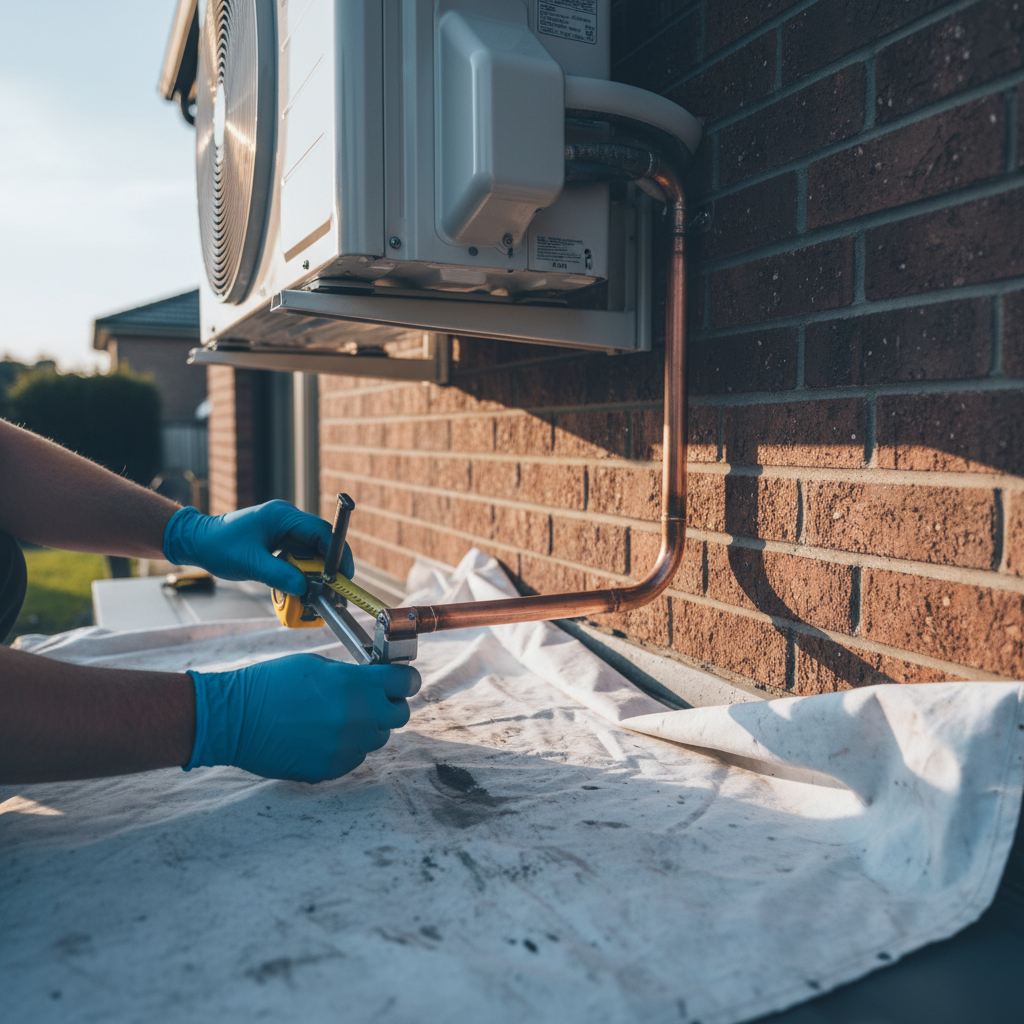
A back-to-back install is the cheapest scenario: the indoor head and the outdoor condenser sit on opposite sides of the same wall, so the refrigerant pipe, drain, and electrical run are short and straight. This is what every "from $X,XXX installed" advertised price assumes. If your wall layout supports it, take it.
A standard single-head install with a slightly longer run — say the indoor head is in a bedroom and the condenser sits 4-6m away around the corner of the house — adds maybe $200-$400 over back-to-back, mostly in extra copper pipe, insulation, and an internal cavity or eaves run.
A multi-head install (one outdoor unit serving 2-5 indoor heads) is a different category entirely. You're typically looking at $4,500-$8,000+ for a 2-3 head system. Per-room cost is lower than buying separate splits, but only if you genuinely need multiple zones — a single bigger split is cheaper if one open-plan area is the actual use case.
A high/low or concealed install (head in a bulkhead, pipe runs through ceiling cavity) sits between standard and multi-head pricing — $2,800-$4,500 for a 5kW depending on how much rectification work the ceiling needs afterwards.
Get a quote in your suburb
See real prices for jobs like this in your area — we use actual quote data from local tradies.
ARCtick licensing — why it affects your quote
Anyone who handles refrigerant in Australia — installing, servicing, decommissioning — must hold a current ARCtick licence. As stated by the regulator: "Refrigeration and air conditioning licensing is administered by the Australian Refrigeration Council." The licence covers both the individual technician (Refrigerant Handling Licence) and the business (Refrigerant Trading Authorisation).
What this means for your quote:
- A legitimate quote will include the installer's ARCtick number, usually in the footer or near the company ABN. If it's not on the quote, ask. If they can't produce one, walk away.
- Cash-job installers offering 20-30% below market rates are almost always uncovered. If something goes wrong — refrigerant leak, compressor failure, water damage from a bad drain — your home insurance can decline the claim because the work was performed by an unlicensed party.
- ARCtick-licensed installers are required to log refrigerant usage. This is partly why the legitimate price floor on a 5kW install is around $1,700-$1,800 — going much lower means corners are being cut on compliance, not just labour.
- The licence also gives you a complaint pathway. If the install fails inside the workmanship warranty period and the installer ghosts you, you can lodge a complaint with the ARC, which can act on the licence.
You should also confirm the electrical side is licensed separately. Refrigerant work and electrical work are two different licences. Many split system installers employ or subcontract a licensed electrician — that's normal — but the Certificate of Compliance for Electrical Work (CCEW in NSW, CES in VIC, Form 4 in QLD, etc.) must be issued by the electrician, not the aircon company.
How to read a split system installation quote
A proper itemised quote should break down something like this:
- Equipment — make, model number, kW capacity, supplier warranty
- Standard installation — labour for back-to-back install, up to X metres of pipe
- Refrigerant lines — copper pipe in metres, including insulation lagging
- Drain line — type (gravity vs condensate pump), length, termination point
- Mounting — wall bracket type, condenser pad or bracket, anti-vibration feet
- Electrical — new RCBO if required, dedicated circuit, isolation switch
- Wall penetration — number of penetrations, wall type, sealing/flashing
- Condenser placement — location, mounting method, distance from boundary
- Old unit removal — degassing, decommissioning, disposal (if applicable)
- Certificate of Compliance — electrical (CCEW/CES/Form 4) and any state-specific refrigerant docs
- GST and total
Red flags on a quote:
- A single line for "supply and install $X,XXX" with no breakdown — this is where the $400 in surprise extras comes from on install day.
- No model number on the unit, just "5kW Daikin" — could be the bottom-of-range Lite or the top-of-range Zena.
- No mention of certificate of compliance — you legally need this for property sale disclosure and insurance.
- "Refrigerant top-up if required" with no rate — get the per-kg rate for R32 in writing ($80-$150/kg is normal).
- A deposit demand over 25% — standard is 10-25% on booking, balance on completion.
When to get multiple quotes
Always — and three quotes is the right number, not two and not five. Two doesn't give you a sense of where the median sits; five wastes everyone's time and you'll struggle to compare apples to apples.
The quotes you want to compare should all specify:
- The same brand and model (or genuinely equivalent — if installer A quotes a Daikin Cora and installer B quotes a Daikin Lite, that's not a comparable quote)
- The same scope — back-to-back vs not, included pipe length, condenser placement, electrical scope
- The same warranty terms — manufacturer warranty plus installer workmanship warranty, both in writing
If the spread between three quotes for the same scope is more than 30%, something is off in either the cheapest or the dearest quote. The cheap one is usually missing line items (you'll be charged on the day for "extras") or the installer isn't covering the work under their ARCtick. The dear one is usually a full-service business with a showroom and a sales rep, where you're paying for overhead more than installation quality.
The sweet spot is the middle quote from a small-to-medium business with a verifiable ARCtick number, an itemised scope, and a workmanship warranty of at least 12 months. That's the install you want.
Frequently asked questions
What's the average cost to install a 5kW split system in Australia?
Expect to pay $1,800-$2,800 fully installed for a mid-tier 5kW back-to-back job in 2026. That's the unit (typically $1,100-$1,600 for a Fujitsu, Mitsubishi Heavy Industries or mid-range Panasonic) plus standard installation. Premium brands like Daikin Cora or Mitsubishi Electric push the installed price closer to $3,200. Anything under $1,500 installed for a 5kW is either a no-name unit, a cash-job installer without ARCtick coverage, or a quote that's missing line items you'll be charged for later.
Why are some quotes double the price for the same unit?
The unit itself is usually only 50-60% of the total. The rest is install complexity: pipe run length (every metre over 3m adds $40-$80), wall penetration material (brick veneer vs double brick vs cladding), condenser placement (ground mount vs bracket vs roof), electrical work (a new RCBO and dedicated circuit can add $300-$600), and whether they're including a Certificate of Compliance. Two quotes for 'a 5kW Daikin' can legitimately differ by $1,000+ once you compare line items.
Can I install a split system myself?
No — not legally, and not safely. Any work involving the refrigerant circuit (which on a split system means everything except mounting the indoor head before connection) requires an ARCtick licence under federal Ozone Protection regulations. The electrical hardwiring also needs a licensed electrician under AS/NZS 3000. DIY 'pre-charged' kits exist but voiding the manufacturer warranty is almost guaranteed, and re-selling the property with unlicensed aircon work is a disclosure problem.
Do I need strata or council approval to install a split system?
In a strata-titled apartment or townhouse, almost always yes — the condenser sits on common property (external wall or balcony) and most by-laws require a written approval, often with conditions on placement, noise rating and a registered installer. Houses generally don't need council approval, but heritage overlays and some Sydney/Melbourne councils restrict street-facing condenser placement. Always check your by-laws or council DA requirements before booking the install — installers won't refund a deposit because strata said no.
How long does a split system install take?
A standard back-to-back single-head install is a 3-5 hour job for a two-person crew. Add 1-2 hours for a longer pipe run, an upper-storey condenser bracket, or a tile/render wall penetration. Multi-head systems (one outdoor unit, multiple heads) typically run a full day or split across two days because each indoor head needs its own pipe run and commissioning. If a quote promises 'one hour install' on a 7kW+ unit, something is being skipped.
What warranty should I expect on a new split system?
Manufacturer warranties from Daikin, Mitsubishi Electric, Mitsubishi Heavy Industries, Fujitsu, Panasonic and LG are 5 years parts and labour on the major Australian residential ranges (some now offer 7 years if installed by an accredited dealer). The installer should also provide a workmanship warranty — typically 12-24 months on labour, fittings and refrigerant charge. Ask for both in writing before paying the balance, and confirm the installer's ARCtick number is recorded on the warranty card or the manufacturer can refuse a claim.
Related guides
Air Conditioner Running Cost Australia (2026): Per Hour, Per Summer, By Size
Air conditioner running costs in 2026: 20 to 35 cents an hour for a bedroom split, up to $1.10 for a living area, $1.50 to $3.50 ducted. How to cut the bill.
Air Con Service & Maintenance Australia: When, How Often, Cost (2026)
Air con servicing in Australia: how often to book, what techs actually do, real 2026 costs ($130-$450), DIY tasks vs ARCtick-only work.
Ducted Air Conditioning Cost Australia (2026): Real Pricing Guide
Real ducted air conditioning cost in Australia: $9k-$25k+ installed by home size, brand, and zoning. Quote red flags and running costs explained.