
Last updated 12 May 2026·Quotcha editorial team — built from real Australian quote data
In this guide
Most Australian homes only think about their air conditioner when it stops working — usually at 38C on a Saturday in January, when every technician within 50km is booked out. A standard split system service runs $130-$220 in 2026, takes under an hour, and the right time to book it is October or November before summer demand hits.
Skipping service does not save money. It defers it — usually into a $1,500-$3,000 compressor replacement instead of a $200 maintenance visit. Here is what a real service includes, what it should cost, and what you can safely do yourself between visits.
How often should you service your air conditioner?
Service frequency depends on system type and where you live, not on what the install manual says generically.
Residential split system: every 12-18 months as a minimum. If you only run it a few weeks a year, you can stretch toward 18 months. If it is your primary heating and cooling, stick to 12.
Ducted system: every 12 months without exception. Ducted units move significantly more air, accumulate more dust through the ductwork, and have more components that can drift out of spec. Annual servicing is also a manufacturer warranty requirement for most brands (Daikin, Mitsubishi Electric, Panasonic, ActronAir all require evidence of annual professional servicing for warranty claims).
Coastal properties (within 1-2km of the ocean): every 6-9 months. Salt spray is brutal on outdoor condenser coils — Manly, Bondi, Glenelg, Cottesloe, Surfers Paradise, you know who you are. Salt accelerates corrosion on the aluminium fins and copper lines, and an unmaintained coastal unit can lose 30-40% of its lifespan.
Commercial / strata / rental: twice yearly. Higher use, more occupants, and insurance/compliance obligations all push the frequency up.
Heavy-use households (kids, pets, allergies, dusty area): every 9-12 months on a split, regardless of system age.
The single best time to book is late October through mid-November. Techs are not yet swamped, you avoid the December callout premium, and the system is verified ready before peak load.
What a professional air con service includes
If a "service" takes 15 minutes and costs $99, you paid for a filter clean. A real service is 45-90 minutes per unit and covers eight distinct checks:
- Filter clean or replacement — pulled out, vacuumed, washed, dried, reinstalled. On heavy-use systems, replaced.
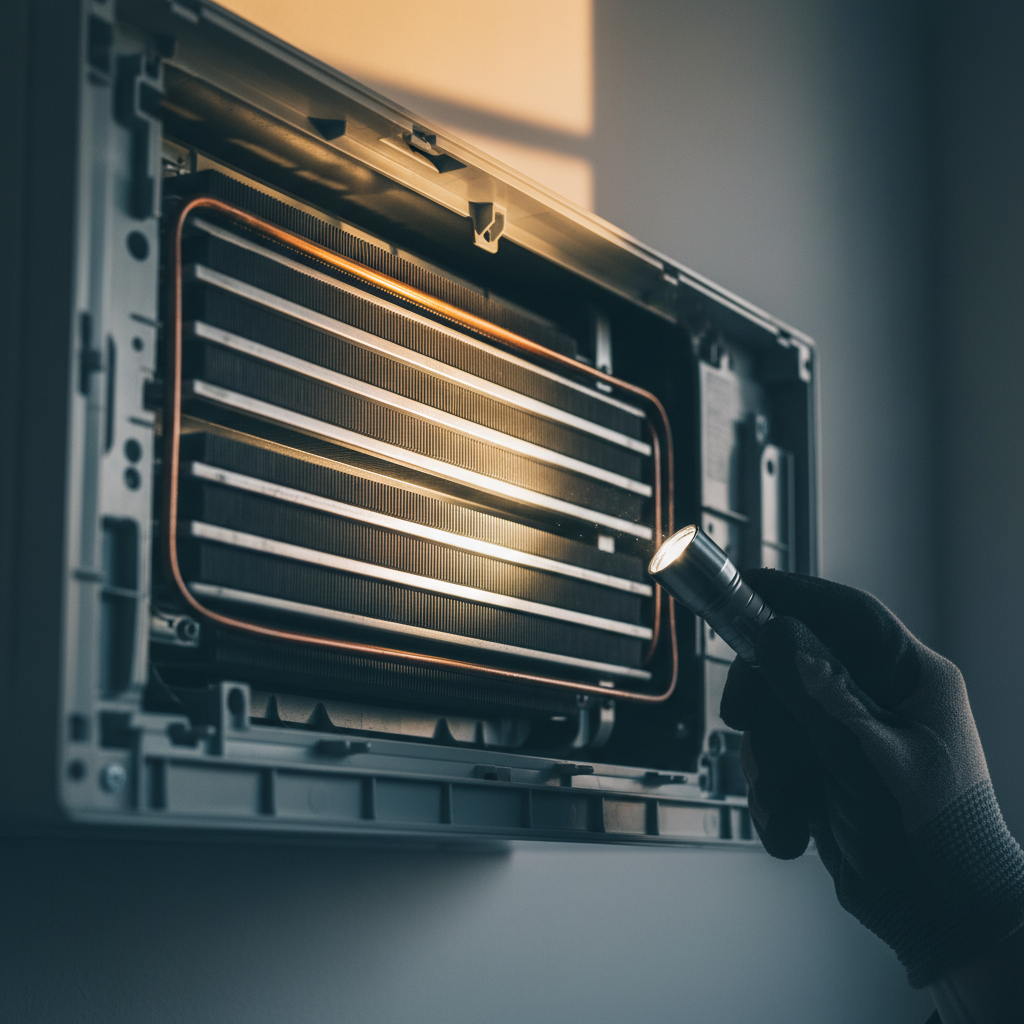
- Indoor coil (evaporator) inspection — checked for dust buildup and biofilm. Coil cleaning is often a separate add-on if it is heavily fouled.
- Outdoor coil (condenser) inspection — fins straightened where bent, debris cleared, gentle wash if needed.
- Condensate drain clearance — the drain line that carries condensation outside is the #1 cause of indoor water leaks. Cleared with a vacuum or compressed air.
- Refrigerant pressure check — gauges connected to verify the system is operating at correct pressures. Low pressure = a leak somewhere.
- Electrical connection check — terminals tightened, contactors inspected, capacitor tested. Loose electrical connections are a common cause of intermittent failure.
- Thermostat calibration — verified that the temperature it is reading matches the actual room temperature.
- Condensate pan clean and fan motor check — pan flushed (mould loves a wet pan), fan motor amp draw measured against spec.
Ask your tech for a written report covering these items. Reputable companies email a checklist after the visit. If they will not provide one, find another company.
Average air con service cost in Australia
Real 2026 pricing across capital cities and regional areas:
- Standard split system service: $130-$220 per unit. Most common job. Sydney and Melbourne metro sit at the top of that range, regional and outer suburbs at the bottom.
- Multi-head split (3-4 indoor heads on one outdoor unit): $250-$400 total. Most companies discount the per-head price after the first.
- Ducted system service: $250-$450. The price spread reflects how many zones, how accessible the outdoor unit is, and whether ductwork inspection is included.
- Comprehensive deep clean (chemical coil clean, mould treatment on indoor unit, anti-microbial spray): add $80-$200 on top of standard service. Worth it every 2-3 years, or sooner if you smell mustiness when the unit starts.
- Refrigerant top-up: $150-$400 depending on gas type and quantity. R32 (newer systems, post-2018ish) is significantly cheaper than R410A (older systems). R22 is phased out and very expensive when available — at that point, replacement usually beats top-up.
- Standalone callout fee (metro Sydney/Melbourne): $80-$120 if you are booking a diagnostic visit not bundled with service work. Often waived if you proceed with the recommended work.
Two pricing red flags to watch for:
- Quotes well under $100 for a "full service" — almost always a filter clean masquerading as a service, with upsells loaded in once they arrive.
- Quotes that bundle a mandatory refrigerant top-up into every service — refrigerant should not need topping up unless there is a leak. A sealed system does not consume refrigerant.
Get a quote in your suburb
See real prices for jobs like this in your area — we use actual quote data from local tradies.
Signs your aircon needs servicing (don't wait)
Your unit usually warns you before it fails. The signals:
- Ice forming on the outdoor unit or refrigerant lines — almost always low refrigerant (leak) or restricted airflow. Turn the unit off and book a tech; running it iced will damage the compressor.
- Water pooling indoors under the indoor unit — blocked condensate drain. Cheap fix if caught early, ceiling/wall damage if ignored.
- Weak airflow from the vents — clogged filter is the first suspect (DIY check first), failing fan motor is the second.
- Musty or mouldy smell when it starts up — biofilm on the evaporator coil and/or in the condensate pan. Needs a chemical clean, not just a filter wash.
- Unusual noises — clicking on startup can be a contactor issue, grinding suggests a fan bearing, hissing or bubbling suggests refrigerant escaping.
- Running constantly without reaching set temperature — refrigerant low, coils heavily fouled, or the unit is undersized for the room.
- Electricity bill jumped without behavior change — efficiency loss from accumulated dust and low refrigerant. A serviced unit often pays back the service cost within one quarter through energy savings.
- The remote shows the temperature you set, but the room never matches — thermostat drift, easily recalibrated during a service.
If you see two or more of these together, do not "see how it goes through summer." Book it.
DIY maintenance vs hiring a pro
There is a small but useful list of things you can safely do yourself between professional services. There is a larger list of things you legally cannot.
Safe DIY tasks:
- Filter cleaning — monthly during heavy use. Power off at the wall, slide the filters out, vacuum, rinse under lukewarm water, dry completely, reinstall. Single biggest efficiency win you can do yourself.
- Outdoor unit hosing — power off, gentle hose pressure (NOT a pressure washer — you will bend the fins and void warranty), wash leaves and dust off the coil. Once or twice a year.
- Visual drain check — look at where the condensate line exits outside the house. Water should drip out when the unit runs in cooling mode. No water, or water indoors, means a blockage.
- Keeping clearance around the outdoor unit — at least 30cm of clear space on all sides. Trim back plants.
- Wiping the indoor unit grilles — damp microfibre cloth, no chemicals.
Do NOT DIY:
- Anything involving refrigerant — illegal without an ARCtick licence under the Ozone Protection and Synthetic Greenhouse Gas Management Act 1989. This includes connecting gauges, "topping up" gas, opening service valves, or repairing refrigerant lines. Penalties for unlicensed handling run into tens of thousands of dollars.
- Electrical work — anything past the wall plug requires a licensed electrician. Outdoor units are typically hard-wired and isolated at a switch — that is electrician territory.
- Opening the indoor unit beyond the filter compartment — the evaporator coil is sharp aluminium and lives next to electrical components and refrigerant lines.
- Pressure-washing any part of the system — bends fins, drives water into electrical components, voids warranty.
- DIY chemical coil cleaning — supermarket "aircon cleaner" sprays often damage coil coatings and can disturb biofilm without removing it. Leave coil cleaning to the service tech.
The honest split: DIY can extend the life and efficiency of your system between services, but it cannot replace a service.
Refrigerant top-ups — when ARCtick licensing matters
If a technician arrives and proposes adding refrigerant to your system, three things must be true:
- They hold a current ARCtick licence (Australian Refrigeration Council). You can ask for the licence number — every legitimate tech carries it. You can also verify it on the ARC website.
- There is a confirmed reason for the top-up. A sealed refrigerant circuit does not consume gas during normal operation. If pressures are low, there is a leak. The leak should be located and repaired before topping up — otherwise you are paying to leak refrigerant into the atmosphere.
- The refrigerant type matches your system. Modern systems (post-2018 typically) use R32. Pre-2018 systems often use R410A. Older systems (pre-2010) may have R22, which is phased out and prohibitively expensive — at that point, replacement usually beats repair.
Pricing reality:
- R32 top-up: $150-$280 typical
- R410A top-up: $220-$400 typical
- R22 top-up: $400+ where even available, and you should be quoting replacement instead
A "top-up only" job with no leak repair is a temporary fix at best. Pay the extra $200-$400 to find and repair the leak, or budget for the same top-up cost again within 6-12 months. Refrigerant escaping into the atmosphere is also illegal to ignore once detected — licensed techs are required to recover, repair, and recharge.
What happens if you skip servicing
Three things, in order, when you skip servicing on a residential split or ducted system:
Year 1 of neglect: efficiency drops 5-10%. You feel it as a slightly higher electricity bill in summer/winter and the unit running longer to hit set temperature. Easy to dismiss.
Year 2-3: dust buildup on the evaporator coil restricts airflow. The unit works harder, the compressor cycles more often, and small refrigerant leaks (typical at flare connections) go undetected. Indoor air quality drops as biofilm builds in the condensate pan.
Year 3+: the warranty has been void for years. Most manufacturer warranties (Daikin, Mitsubishi, Panasonic, ActronAir, Fujitsu) require evidence of annual professional servicing for any major component claim. No service records, no warranty cover. A compressor failure at this point is a $1,500-$3,000 replacement against a unit that may only be worth $2,500-$4,000 — usually a write-off.
Compare against the alternative: $130-$220 per year for a split, or $250-$450 for a ducted system. Across a 10-year unit lifespan that is $1,300-$4,500 in maintenance, against a system that runs at full efficiency, holds warranty cover, and is significantly more likely to reach 12-15 years instead of failing at 7-8.
The maths is not subtle. Service is the single highest-ROI thing you can do for your air conditioner — and it is the easiest to put off. Book it before summer.
Frequently asked questions
How often should I get my air conditioner serviced in Australia?
For a residential split system, every 12-18 months is the minimum — book it before summer (October/November) so you are not joining the December queue. Ducted systems run harder and should be done annually. If you live within 1-2km of the coast, drop that to every 6-9 months because salt corrosion eats outdoor units. Commercial and rental properties typically need twice-yearly servicing to keep warranty and insurance valid.
How much does it cost to service an air conditioner?
A standard split system service in Australia costs $130-$220 per unit in 2026. Multi-head splits with 3-4 heads run $250-$400, ducted systems are $250-$450, and a deep mould/coil clean adds $80-$200. Refrigerant top-ups (if needed) sit at $150-$400 depending on whether your unit uses R32 or the older, pricier R410A. Standalone callouts in metro Sydney or Melbourne are usually $80-$120 before any work begins.
Do I need a licensed technician to service my aircon?
For filter cleaning and a gentle outdoor-unit hose-down, no. For anything touching refrigerant, electrical components, or sealed refrigerant lines, yes — and it is not optional. Under the Ozone Protection and Synthetic Greenhouse Gas Management Act 1989, only ARCtick-licensed technicians can legally handle refrigerant in Australia. Hiring an unlicensed operator voids your warranty and can attract fines up to tens of thousands of dollars for the operator.
What's included in an air conditioning service?
A proper service covers filter clean or replacement, indoor and outdoor coil inspection (and clean if needed), condensate drain clearance, refrigerant pressure check, electrical connection check, thermostat calibration, condensate pan clean, and fan motor inspection. If your tech is in and out in 15 minutes for $99, you got a filter clean — not a service. A genuine service takes 45-90 minutes per unit.
How do I know if my aircon needs more than just a service?
Ice forming on the outdoor unit, water pooling indoors, refrigerant smell (sweet/chemical), the compressor cycling on and off rapidly, or a system that cools fine for 10 minutes then blows warm — these point to a refrigerant leak, failing capacitor, or compressor issue rather than a dirty filter. Get a diagnostic quote, and if a tech recommends a $1,500+ repair on a unit older than 10 years, get a replacement quote alongside it before you commit.
Can I clean the aircon filter myself?
Yes, and you should — monthly during heavy use (summer/winter peak). Switch the unit off at the wall, pop the front panel open, slide the filters out, vacuum the loose dust, then rinse under lukewarm water with a soft brush. Dry them fully before reinstalling — wet filters grow mould fast. Clean filters alone improve efficiency by 5-15% and are the single biggest DIY win.
Related guides
Air Conditioner Running Cost Australia (2026): Per Hour, Per Summer, By Size
Air conditioner running costs in 2026: 20 to 35 cents an hour for a bedroom split, up to $1.10 for a living area, $1.50 to $3.50 ducted. How to cut the bill.
Ducted Air Conditioning Cost Australia (2026): Real Pricing Guide
Real ducted air conditioning cost in Australia: $9k-$25k+ installed by home size, brand, and zoning. Quote red flags and running costs explained.
Split System Air Conditioner Installation Cost Australia (2026)
Split system installation cost in Australia: $1,200 for 2.5kW back-to-back, $2,800-$4,500 for 9kW. Real line items, ARCtick rules, what changes the price.