
Last updated 24 August 2026·Quotcha editorial team — built from real Australian quote data
In this guide
A hot water system fails on its own schedule, usually a cold shower on a winter morning, and the replacement decision gets made in an hour under pressure. That is exactly when homeowners overpay. In 2026 a like-for-like electric storage swap runs $1,400 to $2,400 installed, a gas storage or continuous flow unit $1,800 to $3,500, and a heat pump $3,000 to $5,500 before rebates that can knock $800 to $1,500 off in some states.
The numbers below come from real quotes across Sydney, Melbourne, Brisbane, Perth and regional areas. Use them to know when a quote is fair, when it is padded, and which system type actually makes sense for your house.
What a hot water replacement costs in 2026
Installed prices for a standard residential swap, including the unit, labour, basic fittings, removal of the old unit and GST. Assumes the new system goes where the old one was.
- Electric storage, 125L to 160L (1 to 3 people): $1,400 to $2,100
- Electric storage, 250L to 315L (3 to 5 people): $1,800 to $2,600
- Gas storage, 135L to 170L: $1,900 to $2,900
- Gas continuous flow (instantaneous), 20L to 26L/min: $2,000 to $3,500
- Heat pump, 200L to 300L: $3,000 to $5,500 installed, $1,600 to $4,200 after rebates where available
- Solar with electric or gas boost, roof mounted: $4,500 to $8,000
The unit is typically 55 to 70 percent of the total. A Rheem, Rinnai, Dux or Bosch electric 250L sells for $1,100 to $1,600 at trade; a Rinnai Infinity 26 continuous flow is $1,300 to $1,800; a mid-range heat pump from Reclaim, Sanden, iStore or Rheem is $2,200 to $4,000.
Labour for a straightforward swap is 2 to 4 hours, so at plumber rates of $110 to $180 an hour you are paying $400 to $700 for the install itself. Anything much beyond that on a like-for-like job needs a line item explaining it.
What pushes the price up
Two quotes for the same 250L Rheem can differ by $800 or more for legitimate reasons. These are the ones that matter.
Changing fuel type. Going from gas to electric or electric to heat pump means new circuits or new gas lines. A dedicated circuit and isolator from an electrician adds $350 to $700. Running a new gas line adds $400 to $900 depending on distance from the meter.
Moving the unit. Relocating from inside a cupboard to an external wall, or from one side of the house to the other, means new pipework, a new drain for the pressure relief valve and possibly a new base. Budget $500 to $1,200 extra.
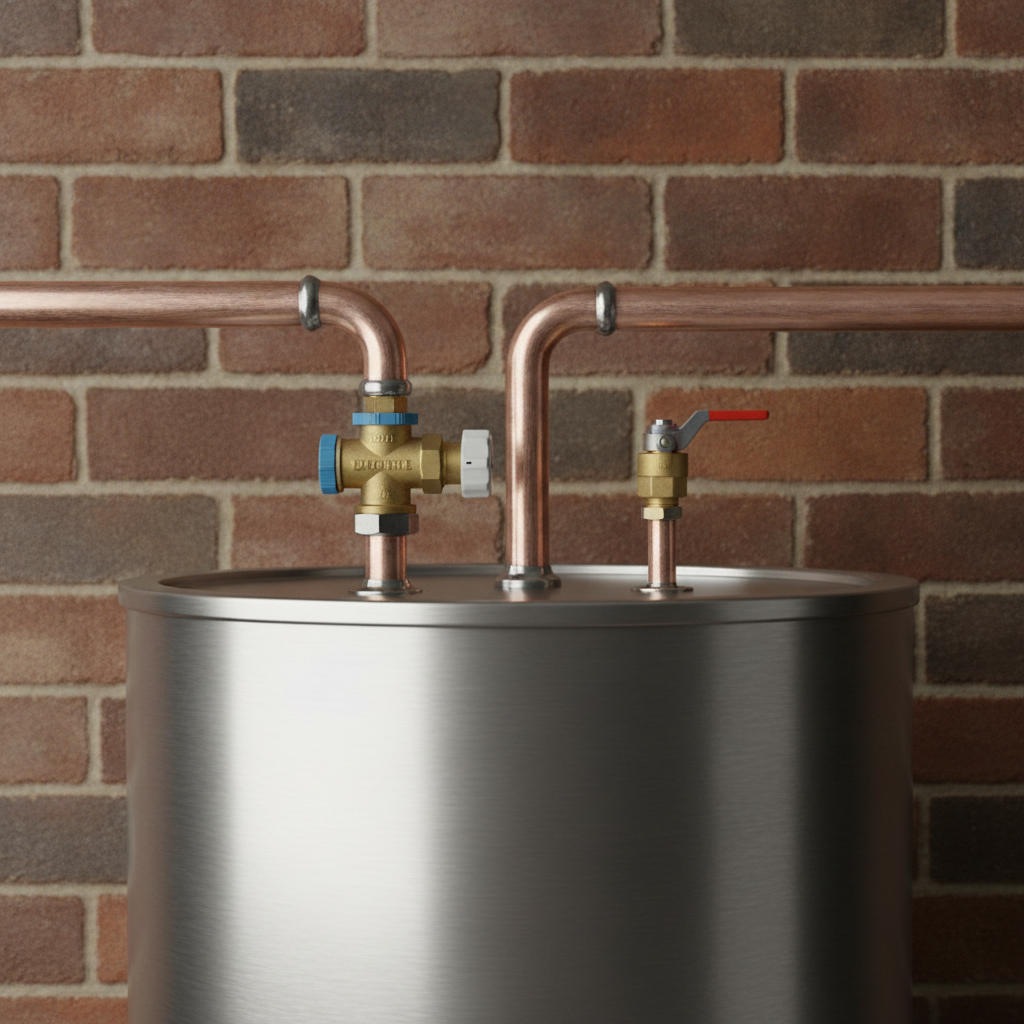
Tempering valve and compliance. Every replacement in Australia must deliver water to bathrooms at no more than 50C, which means a tempering valve (AS 3500.4). If your old system predates that rule, add $150 to $300. A quote that skips it is not compliant.
Access. A unit in a tight roof space, a sub-floor or a second-storey balcony adds labour and sometimes a second person. Expect $200 to $500.
Old unit disposal. Usually included. If it is listed separately it should be $50 to $120, not $250.
Emergency and after-hours callout. Weekend or same-day attendance adds $150 to $350. Worth it if you have no hot water and a family, avoidable if you can wait until Monday.
Which system type should you choose?
The cheapest unit to buy is rarely the cheapest to own. Running cost over a typical 10 to 12 year life is where the real money sits.
Electric storage is the cheapest to install and the most expensive to run, roughly $600 to $1,000 a year for a family of four on a standard tariff. It suits small households, rentals and anywhere the budget only stretches to a like-for-like swap. On a controlled load (off-peak) tariff the running cost drops by a third.
Gas storage and continuous flow run $400 to $700 a year for a family and continuous flow never runs out. Gas prices have risen sharply since 2022, so the gap over electric has narrowed, and several states are moving away from new gas connections. If you already have gas it remains a sensible choice; if you do not, it is rarely worth connecting for hot water alone.
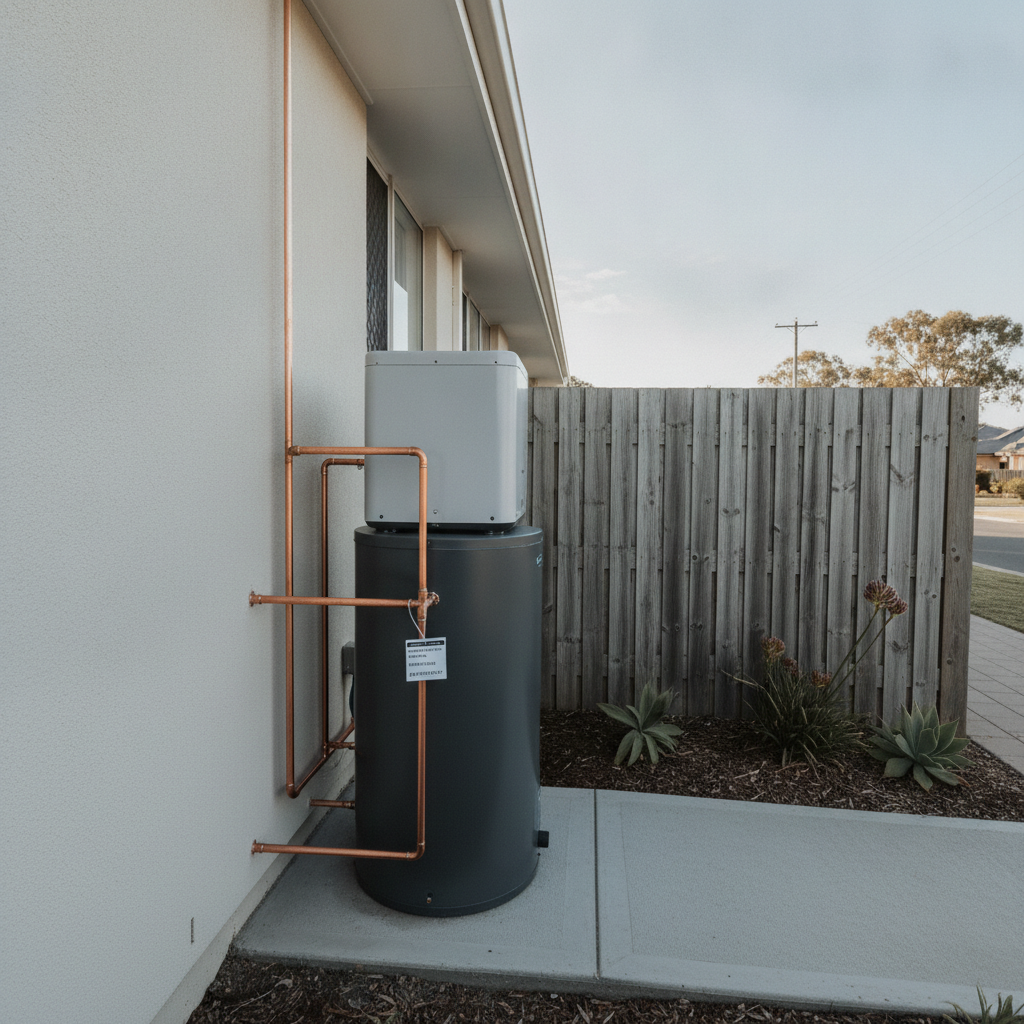
Heat pumps use a third of the electricity of a storage unit, so a family of four pays $200 to $400 a year, and less again if you have solar and time the unit to run in the middle of the day. The catch is the upfront price and the noise: they have a fan like an air conditioner, so placement near a bedroom window (yours or the neighbour's) matters. Rebates through the federal STC scheme, the Victorian Solar Homes program and the NSW Energy Savings Scheme are what make the maths work; ask the installer to show the rebate as a line item.
Solar hot water is the lowest running cost of all but needs roof space, a north-facing aspect and a booster for cloudy weeks. With heat pump prices where they are now, most installers steer new customers to a heat pump unless the roof is ideal.
Get a quote in your suburb
See real prices for jobs like this in your area — we use actual quote data from local tradies.
Repair or replace?
A tank that is leaking from the cylinder itself is finished; the steel has rusted through and no repair will hold. Replace it.
Everything else is worth a diagnosis first, because the common faults are cheap:
- No hot water, electric unit: usually the element ($150 to $300 to replace) or the thermostat ($120 to $250)
- Pressure relief valve dripping constantly: $120 to $220 to replace the valve
- Gas unit not igniting: thermocouple or ignition module, $150 to $350
- Water not hot enough: thermostat or, on a gas unit, a partially blocked burner, $120 to $300
The rule of thumb plumbers use: if the unit is under eight years old and the repair is under a third of the replacement cost, repair it. If it is over ten years old, put the repair money towards a replacement, because the next fault is close behind.
Check the date on the compliance plate. Storage tanks carry a 5 to 10 year cylinder warranty, and a unit still inside its warranty may be replaced by the manufacturer at no cost for the tank (you pay labour).
What a good hot water quote includes
A quote you can compare against another quote lists:
- The exact unit: brand, model number, capacity and energy rating
- Whether it is like-for-like or a fuel change, and any electrical or gas work as separate lines
- Tempering valve, pressure relief valve and any new isolation valves
- Removal and disposal of the old unit
- Any rebates applied and the rebate scheme by name
- Warranty on the unit (tank and parts separately) and on the workmanship
- The plumber's licence number and, for gas, their gasfitting endorsement
Two quotes that just say "replace hot water system, $2,400" cannot be compared. Ask for the model number at minimum; the price difference between a 160L and a 250L of the same brand is $300 to $500, and you want to know which one you are getting.
Licensing and compliance
Hot water replacement is licensed plumbing work in every state, and gas units also require a licensed gasfitter. NSW Fair Trading, the Victorian Building Authority, QBCC in Queensland, and the equivalent bodies elsewhere all publish a public licence search. The licence number belongs on the quote.
The plumber must also lodge a compliance certificate after the job in most states (a Certificate of Compliance in NSW, a Compliance Certificate through the VBA in Victoria, a Form 4 in Queensland). It is your proof the work meets AS 3500 if you sell the house or make an insurance claim. If nobody mentions it, ask.
Timing your replacement
The best time to replace a hot water system is before it fails. A unit that is 10 to 12 years old, showing rust at the base or making rumbling noises as sediment builds up, is telling you. Replacing it on your own timeline means you can get two or three quotes, wait for a heat pump rebate round, and book a weekday install at standard rates.
A failed unit on a Sunday means one quote, an emergency callout fee and whatever is on the van.
The bottom line
Expect $1,400 to $2,600 for a like-for-like electric swap, $2,000 to $3,500 for gas, and $3,000 to $5,500 for a heat pump before rebates. If your quote lands well above those ranges, the explanation should be visible on the page: a fuel change, a relocation, a difficult access job. If it is not there, ask, or get a second quote.
Frequently asked questions
How much does it cost to replace a hot water system in Australia?
In 2026 a like-for-like electric storage swap costs $1,400 to $2,600 installed, a gas storage or continuous flow unit $1,900 to $3,500, and a heat pump $3,000 to $5,500 before rebates. The unit is 55 to 70 percent of the total; labour on a straightforward swap is 2 to 4 hours at $110 to $180 an hour.
Is a heat pump hot water system worth it?
For most households with three or more people, yes. A heat pump uses about a third of the electricity of a storage unit, so running costs fall from $600 to $1,000 a year to $200 to $400, and federal STC rebates plus state schemes (Victoria, NSW) often cut the upfront price by $800 to $1,500. The trade-offs are the higher purchase price and fan noise, so placement away from bedrooms matters.
Should I repair or replace my hot water system?
A cylinder that is leaking from the tank itself cannot be repaired. Everything else is worth diagnosing first: elements, thermostats, relief valves and thermocouples are $120 to $350 to replace. The rule of thumb is repair if the unit is under eight years old and the fix is under a third of a replacement, and replace if it is over ten years old.
How long does a hot water system last?
Electric and gas storage tanks last 10 to 15 years; continuous flow gas units 15 to 20 years; heat pumps 10 to 15 years; solar systems 15 to 20 with a booster replacement in between. Water quality, tank material (stainless versus vitreous enamel) and whether the sacrificial anode has ever been replaced make the difference between the low and high end.
Do I need a licensed plumber to replace a hot water system?
Yes, in every state, and a gas unit also needs a licensed gasfitter. The plumber must install a tempering valve so bathroom water is no hotter than 50C, and lodge a compliance certificate afterwards. Ask for the licence number and the certificate; both protect you at sale time and on insurance claims.
Why did my hot water quote include a tempering valve?
Australian Standard AS 3500.4 requires water delivered to bathrooms and ensuites to be no hotter than 50C to prevent scalding. If your existing system predates the rule, a tempering valve ($150 to $300 fitted) must be added with the new unit. A quote that leaves it out is not compliant, and a plumber cannot legally certify the job without it.