
Last updated 24 August 2026·Quotcha editorial team — built from real Australian quote data
In this guide
Charging an electric car from a normal power point works, in the way that filling a bath with a teacup works. A dedicated home charger cuts a full charge from 30 hours to 6 to 8, and in 2026 installing one costs $1,400 to $2,800 for a standard single-phase job, $2,500 to $4,500 where the switchboard needs an upgrade, and $800 to $1,200 more again for three-phase. The charger itself is $700 to $1,800 of that.
The install quote is where the price varies, not the hardware. Here is what a real installation involves, why two quotes for the same 7kW charger can differ by $1,500, and what a licensed electrician must include for the job to be legal.
EV charger installation cost in 2026
Installed prices including the charger, a dedicated circuit, protection, labour and a compliance certificate:
- 7kW single-phase wallbox, garage within 5m of the switchboard: $1,400 to $2,200
- 7kW single-phase, 10m to 20m cable run or external wall mount: $1,900 to $2,800
- 7kW with a switchboard upgrade required: $2,500 to $4,500
- 11kW or 22kW three-phase wallbox (house already has three-phase): $2,200 to $3,500
- Three-phase upgrade to the property (new supply): $2,500 to $6,000 on top, plus network connection fees that vary by distributor
- Load-management or solar-aware charger (Zappi, Wallbox Pulsar Plus, Tesla Wall Connector with dynamic load): add $300 to $700 to the hardware
A basic 7kW charger from Tesla, Wallbox, myenergi or Ocular sells for $700 to $1,300. Smart chargers with app control, scheduling and solar diversion sit at $1,100 to $1,800. Chargers that ship with the car (portable 10A or 15A leads) are not wall chargers and do not need a licensed install beyond a suitable power point.
What the electrician is actually doing
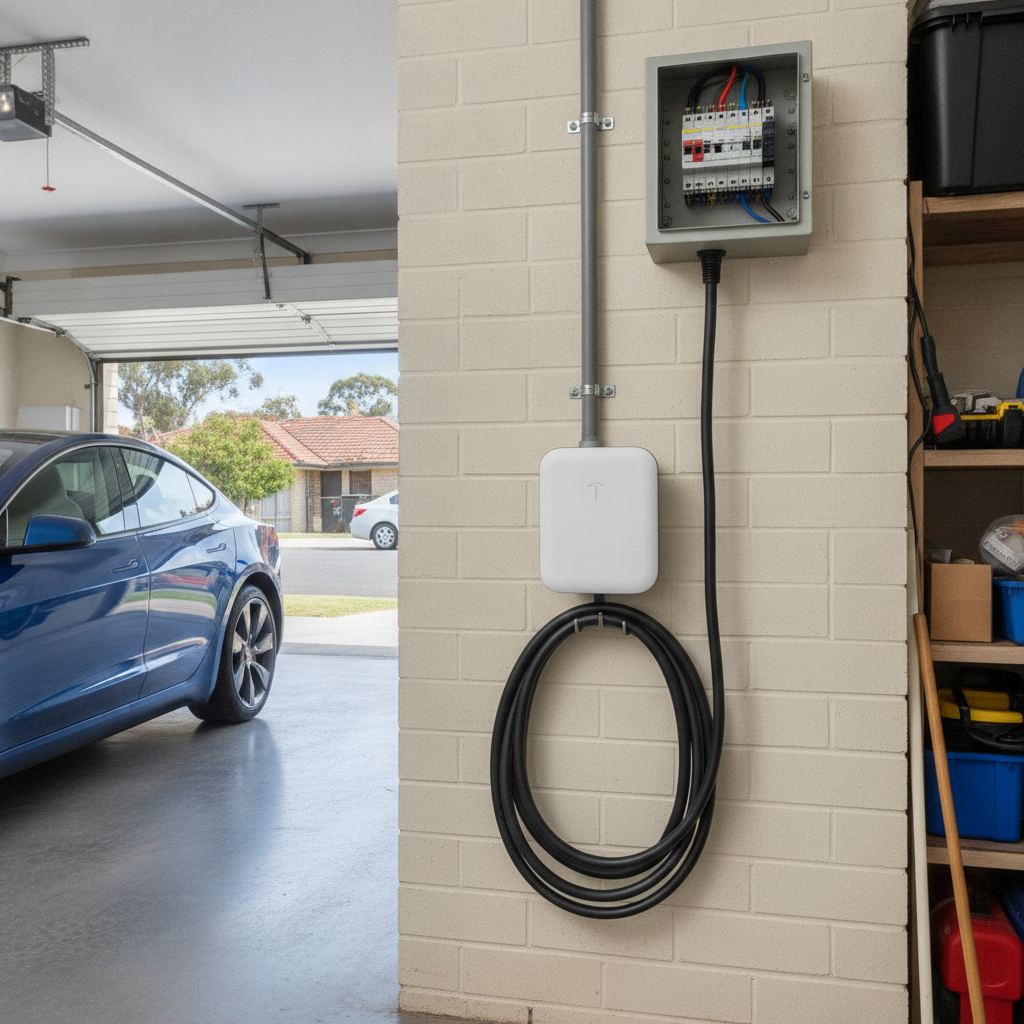
A 7kW charger draws 32 amps continuously for hours, which is more than an oven and far more than any power point is rated for. The installation is a new circuit, not a plug:
- A dedicated circuit from the switchboard to the charger location, typically 6mm2 cable for runs under 20m and 10mm2 beyond that (cable size against run length is the most common corner cut)
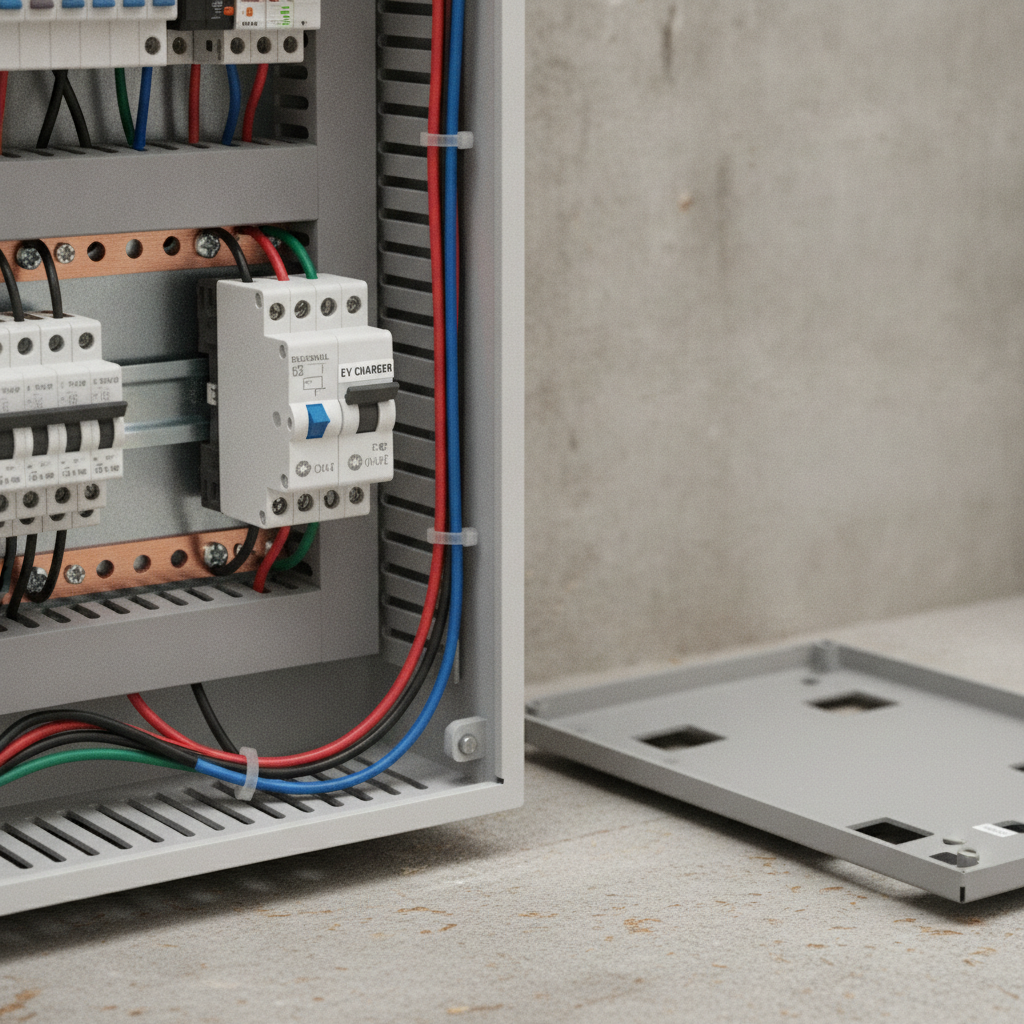
- A dedicated RCD or RCBO with Type A or Type B protection depending on the charger, as required by AS/NZS 3000 for EV supply equipment
- An isolation switch at the charger
- Mounting and commissioning of the wallbox, including pairing to Wi-Fi or an app where relevant
- A Certificate of Compliance (a CCEW in NSW, a Certificate of Electrical Safety in Victoria, a Certificate of Testing and Safety in Queensland) lodged with the state regulator
Any quote that describes the job as "install charger" with no circuit, no protection device and no certificate is missing the parts that make it safe and legal.
What pushes the price up
Cable run length and route. Every metre past the first few adds $30 to $60 in cable and labour, and a run that has to go through a ceiling, under a slab or along an external wall in conduit costs more than one down the garage wall next to the switchboard. Charger placement is the cheapest variable you control.
Switchboard capacity. Older boards with ceramic fuses, no spare poles or no main switch cannot take a 32A circuit. A board upgrade is $1,800 to $4,500 and is worth doing once for the EV, the induction cooktop and the heat pump you will want later. See the switchboard upgrade guide for detail.
Supply capacity. A house on a 63A single-phase supply running a ducted air conditioner, an electric hot water system and a 32A charger at once can exceed its supply. The options are a three-phase upgrade (expensive, sometimes slow through the distributor) or a charger with dynamic load management that throttles itself when the house is busy. Load management adds $300 to $700 and is usually the better answer for a single EV.
External mounting and weatherproofing. A charger on a carport post or external wall needs an IP-rated enclosure, weatherproof conduit and possibly a post. Add $200 to $500.
Apartment and strata. Charging in a shared car park is a different job entirely: metering, owners corporation approval, load sharing across bays and often a building-wide plan. Budget $3,000 to $8,000 per bay and expect months of approval.
Get a quote in your suburb
See real prices for jobs like this in your area — we use actual quote data from local tradies.
Which charger size do you need?
- 7kW single-phase adds around 40km of range per hour and fully charges most EVs overnight. It is the right answer for the large majority of households.
- 11kW three-phase adds around 60km an hour. Useful if you have three-phase already and two EVs, or a car with a large battery and a short overnight window.
- 22kW three-phase is faster than most cars can accept on AC; many vehicles are limited to 7kW or 11kW onboard. Check the car before paying for capacity it cannot use.
If you have solar, a solar-aware charger that diverts excess generation into the car is worth the premium. Charging from your own panels in the middle of the day is the cheapest kilometre you will ever drive.
Rebates and incentives
Incentives change frequently and vary by state. As of 2026 some state programs and energy retailers offer rebates or discounted tariffs for home charger installation, and several distributors offer cheaper off-peak or "EV" tariffs for overnight charging. Ask the electrician what currently applies in your postcode and get the rebate shown on the quote as a line item, not a verbal promise.
Licensing and compliance
EV charger installation is prescribed electrical work in every state. Only a licensed electrician can do it, the circuit must comply with AS/NZS 3000 and the EV-specific provisions, and a compliance certificate must be issued and lodged. Some chargers also require the installer to be accredited by the manufacturer for the warranty to apply; Tesla and Wallbox both run installer programs.
Ask for the licence number, the certificate, and confirmation the charger's warranty is valid with this installer. A cheap install that voids a $1,500 charger's warranty is not cheap.
What a good EV charger quote includes
- Charger brand and model, with its capacity (kW) and whether it includes load management or solar diversion
- Cable size and route, with the run length
- The protection device type (RCD/RCBO, Type A or B)
- Whether the switchboard needs work, and if so, priced separately
- Mounting location and any external weatherproofing
- The compliance certificate
- Warranty on the charger and on the workmanship
- The electrician's licence number
The bottom line
Expect $1,400 to $2,800 for a standard 7kW home charger install in 2026, and $2,500 to $4,500 if your switchboard is old. Put the charger as close to the switchboard as your parking allows, choose load management over a three-phase upgrade unless you have a second reason for three-phase, and treat the compliance certificate as part of the price, not an extra.
Frequently asked questions
How much does it cost to install an EV charger at home in Australia?
A standard 7kW single-phase wallbox installed within a few metres of the switchboard costs $1,400 to $2,200 in 2026, or $1,900 to $2,800 with a longer cable run or external mounting. If the switchboard needs upgrading, budget $2,500 to $4,500. The charger itself is $700 to $1,800 of that; the rest is the dedicated circuit, protection, labour and the compliance certificate.
Do I need three-phase power for an EV charger?
No. A 7kW single-phase charger adds around 40km of range per hour and fully charges most EVs overnight, which suits the large majority of households. Three-phase (11kW or 22kW) only makes sense if you already have it, or you have two EVs and a short charging window. For a house near its supply limit, a charger with dynamic load management ($300 to $700 extra) is usually a better answer than a $2,500 to $6,000 three-phase upgrade.
Can I plug my EV into a normal power point?
Yes, using the portable lead that comes with most cars, but a standard 10A outlet adds only 10 to 12km of range per hour and a full charge can take 30 hours. A dedicated 32A circuit and wall charger cuts that to 6 to 8 hours. The portable lead does not require a licensed installation; a wall charger always does.
Why does my EV charger quote include a switchboard upgrade?
A 7kW charger draws 32 amps continuously, which needs its own circuit and a dedicated RCD or RCBO with Type A or Type B protection under AS/NZS 3000. Older boards with ceramic fuses, no spare poles or no main switch cannot take that circuit safely. A board upgrade ($1,800 to $4,500) is worth doing once, because the induction cooktop and heat pump you add later will need it too.
Does an EV charger need a licensed electrician?
Yes. It is prescribed electrical work in every state: only a licensed electrician can install it, the circuit must comply with AS/NZS 3000 and its EV provisions, and a compliance certificate must be issued and lodged. Some manufacturers (Tesla, Wallbox) also require an accredited installer for the charger warranty to apply, so ask for the licence number, the certificate and warranty confirmation.
Where should I put my EV charger to keep the cost down?
As close to the switchboard as your parking allows. Every metre of cable past the first few adds $30 to $60, and a run through a ceiling, under a slab or along an external wall in conduit costs more than one straight down the garage wall. External mounting needs weatherproofing at an extra $200 to $500. Charger placement is the cheapest variable you control.
Related guides
Electrician Hourly Rate & Day Rate Australia (2026): What You Should Pay
Australian electrician hourly rates in 2026: $90-$140/hr metro, callout fees, after-hours surcharges, and how to spot a padded quote.
Switchboard Upgrade Cost Australia (2026): Real Pricing & What to Expect
Switchboard upgrade cost in Australia ranges $1,800-$6,500 in 2026. Real pricing by pole count, asbestos add-ons, RCBO requirements & quote red flags.